CELLFORGE // SCIENTIFIC FOUNDATION 001
THE ADAPTIVE
ORGANISM
The human body is not static.
It is an adaptive biological system.
A scientific framework for understanding
how cells, tissues and physiological
systems respond to repeated signals.
BIOLOGICAL SYSTEM // 001
CELLULAR RESPONSE
SIGNAL → ADAPTATION
HOMEOSTATIC REGULATION
ON THIS PAGE
01 // THE CELL
SAME GENOME.
DIFFERENT EXPRESSION.
At the foundation of every human tissue lies the cell.
Muscle fibers generate force. Neurons transmit electrochemical signals. Keratinocytes contribute to the protective barrier of the skin. Fibroblasts produce and remodel components of the extracellular matrix.
These cells perform radically different functions, yet most nucleated cells within one individual contain essentially the same genome.
What differs is not simply the DNA they possess.
What differs is how that genetic information is regulated and expressed.
Different genes can be activated or suppressed in different cells and under different conditions. RNA is produced, proteins are synthesized, signaling networks change and cellular behavior follows.
The genome therefore should not be imagined as a static instruction sheet that produces one inevitable outcome.
It exists inside a dynamic regulatory system.
SAME GENOME.
DIFFERENT EXPRESSION.
DIFFERENT CELL.
DIFFERENT FUNCTION.
EVIDENCE LEVEL // ESTABLISHED
02 // THE PROGRAM
BIOLOGY IS NOT STATIC CODE.
IT IS A REGULATORY SYSTEM.
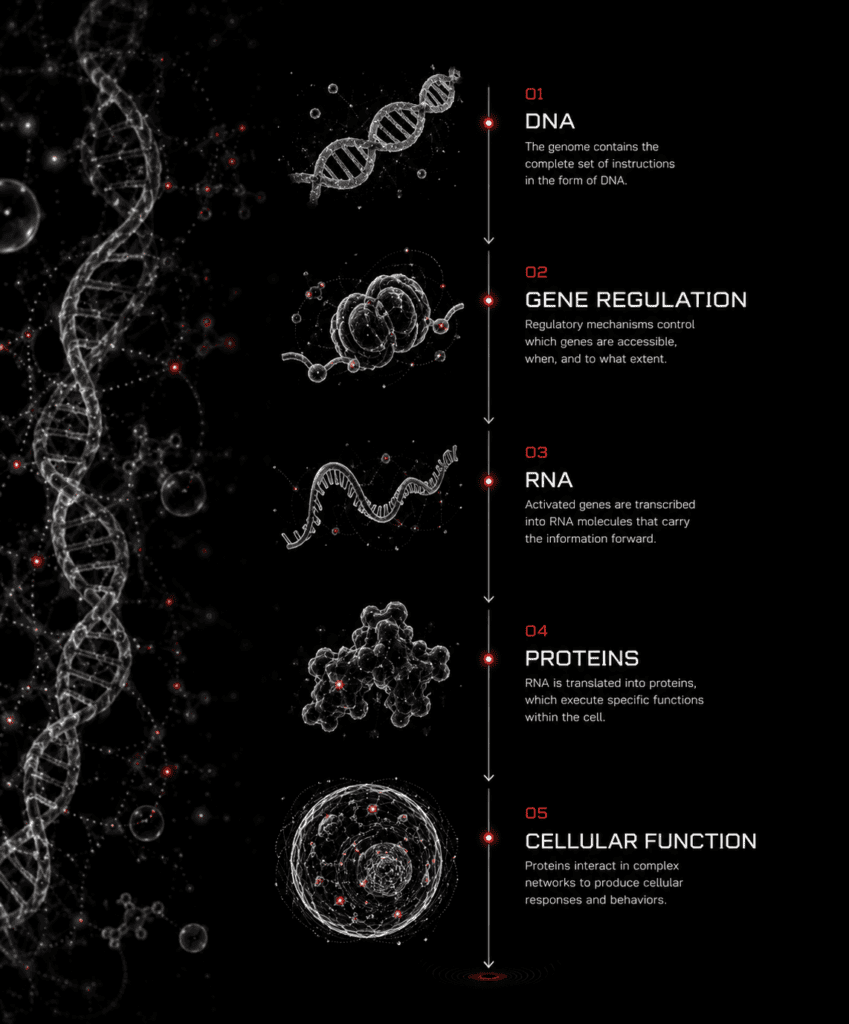
DNA contains biological information.
But DNA alone does not determine what a cell is doing at every moment.
A simplified sequence looks like this:
DNA
↓
GENE REGULATION
↓
RNA
↓
PROTEINS
↓
CELLULAR FUNCTION
This process is controlled at multiple levels.
Transcription factors influence which genes are transcribed. Chromatin structure affects accessibility to DNA. Signaling pathways alter regulatory proteins. RNA can itself be processed and regulated. Proteins can subsequently be modified, activated, transported or degraded.
The result is not a rigid computer program.
It is a biological regulatory network.
Feedback occurs at almost every level.
THE PROGRAM IS DYNAMIC.
And this distinction matters.
When CELLFORGE uses the language of reprogramming, we are not claiming that a person can consciously rewrite DNA or command cells to perform arbitrary functions.
We are describing something both less magical and more interesting:
BIOLOGICAL SYSTEMS CHANGE THEIR BEHAVIOUR IN RESPONSE TO CONDITIONS.
EVIDENCE LEVEL // ESTABLISHED
03 // THE SIGNAL
THE CELL DOES NOT ACT
IN ISOLATION.
IT RESPONDS TO SIGNALS.
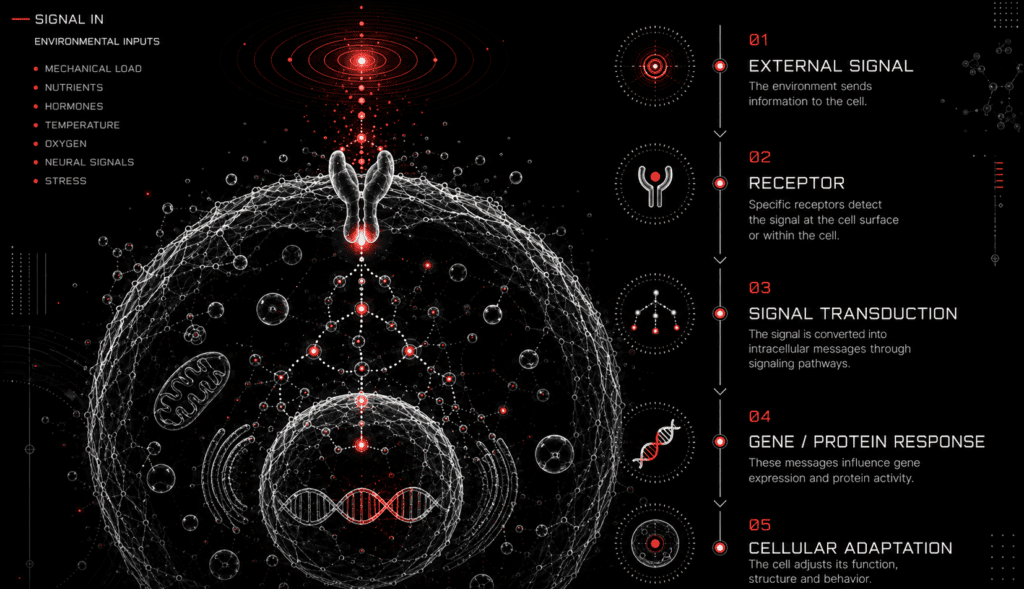
Cells continuously receive information from their environment.
Mechanical forces, nutrients, hormones, temperature, oxygen availability and neural signals can influence cellular activity.
These inputs are detected and translated into intracellular signalling processes.
FROM SIGNAL TO RESPONSE
A skeletal muscle does not understand the concept of a workout.
Its cells experience altered conditions.
THE INPUT
Mechanical tension. Changes in calcium concentrations. Energy demand. Metabolites. Hormonal signals. Oxygen availability. Temperature. Nutrient availability. Neural activity.
THE DETECTION
These conditions can be detected through receptors, ion channels, mechanosensitive structures and intracellular molecular sensors.
The external event becomes an internal signal.
And the signal can become a biological response.
THE DISTINCTION
The environment does not rewrite the genome.
It changes how biological systems respond within
the possibilities of that genome.
CHANGE THE SIGNAL.
CHANGE THE RESPONSE.
EVIDENCE LEVEL // ESTABLISHED
04 // THE RESPONSE
A RESPONSE IS TEMPORARY.
ADAPTATION IS ACCUMULATED.
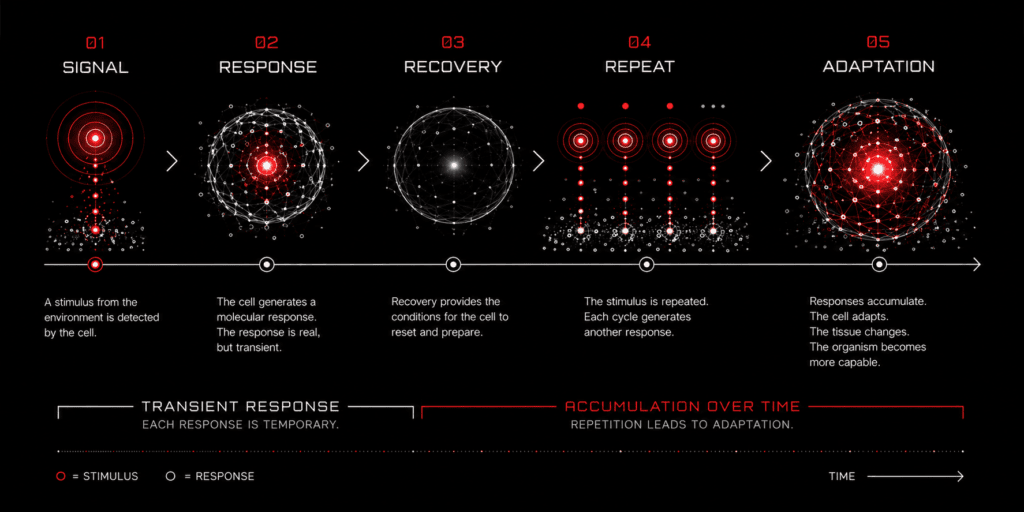
A single exposure can create a response.
A single bout of exercise can produce transient changes in gene expression in skeletal muscle.
Those molecular responses do not mean the muscle has instantly transformed.
REPEATED EXPOSURE
When appropriate stimuli are repeated, individual transient responses can contribute to the accumulation of proteins, structural remodeling and longer-term changes in tissue phenotype.
CONDITIONS FOR ADAPTATION
Training supplies information to a biological system.
Recovery supplies conditions under which aspects of the response can occur.
Nutrition supplies substrates.
Time allows repeated responses to accumulate.
THE RESULT
Repetition changes what the organism becomes capable of doing.
THE DISTINCTION
The environment does not rewrite the genome.
It changes how biological systems respond within
the possibilities of that genome.
THE SIGNAL IS TEMPORARY.
ADAPTATION IS ACCUMULATED.
EVIDENCE LEVEL // ESTABLISHED
05 // ADAPTATION
ADAPTATION IS THE RESULT
OF REPEATED BIOLOGICAL WORK.
Adaptation is not a single event.
It emerges from repeated biological responses over time.
When a stimulus is applied repeatedly, the organism can alter its structure, function and capacity in ways that improve its ability to meet that demand.
RESISTANCE TRAINING
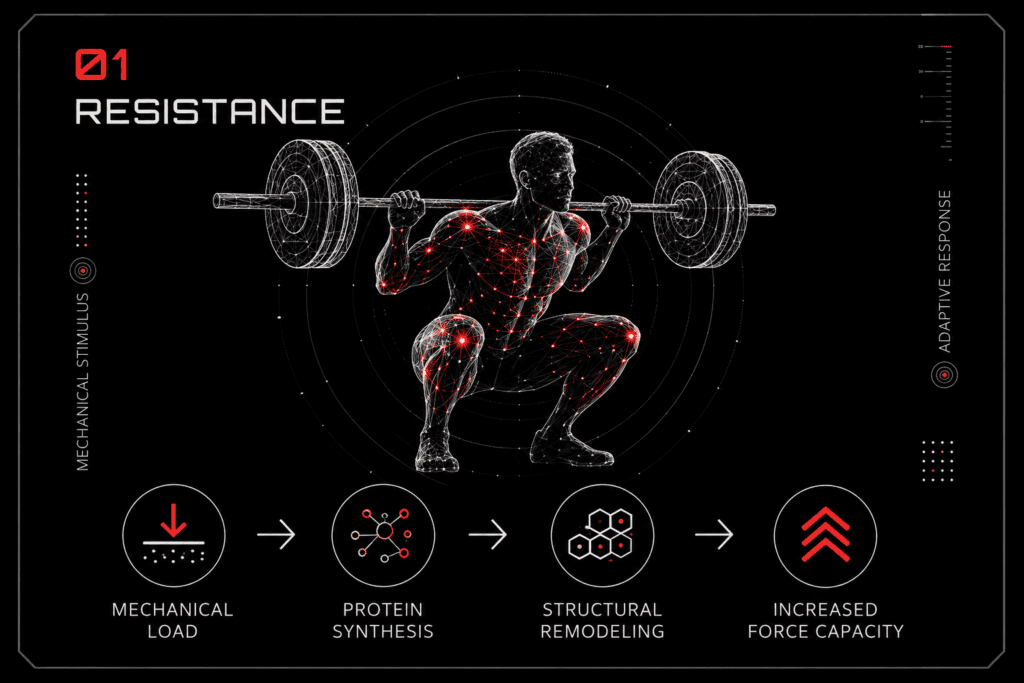
Repeated mechanical loading can stimulate molecular pathways involved in protein synthesis and tissue remodeling.
Over time, these responses contribute to changes in muscle structure and force-producing capacity.
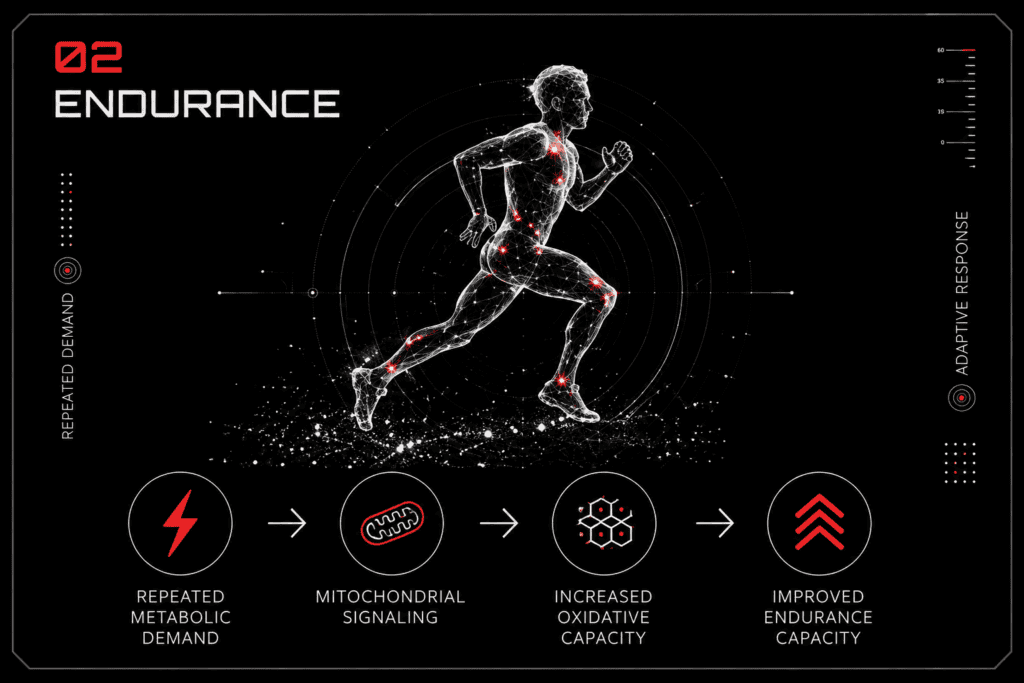
ENDURANCE TRAINING
Repeated endurance demands can influence mitochondrial biogenesis, oxidative enzymes and vascular adaptations.
The result is an increased capacity to produce energy under sustained demand.
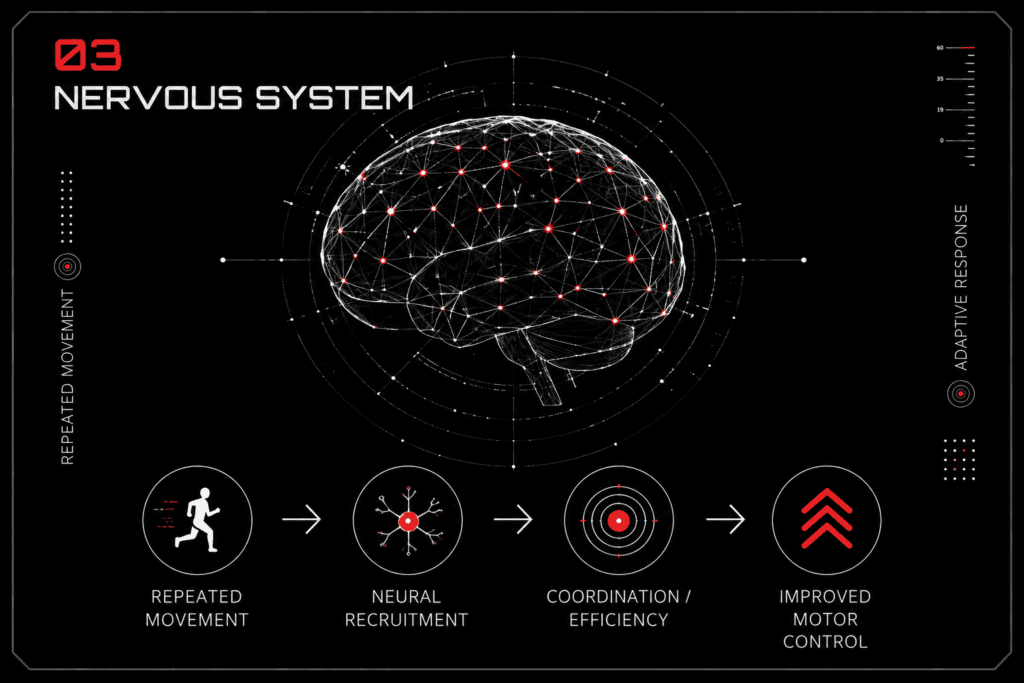
NERVOUS SYSTEM
Adaptation is not limited to muscle tissue.
Repeated practice can alter neural recruitment, coordination and movement efficiency.
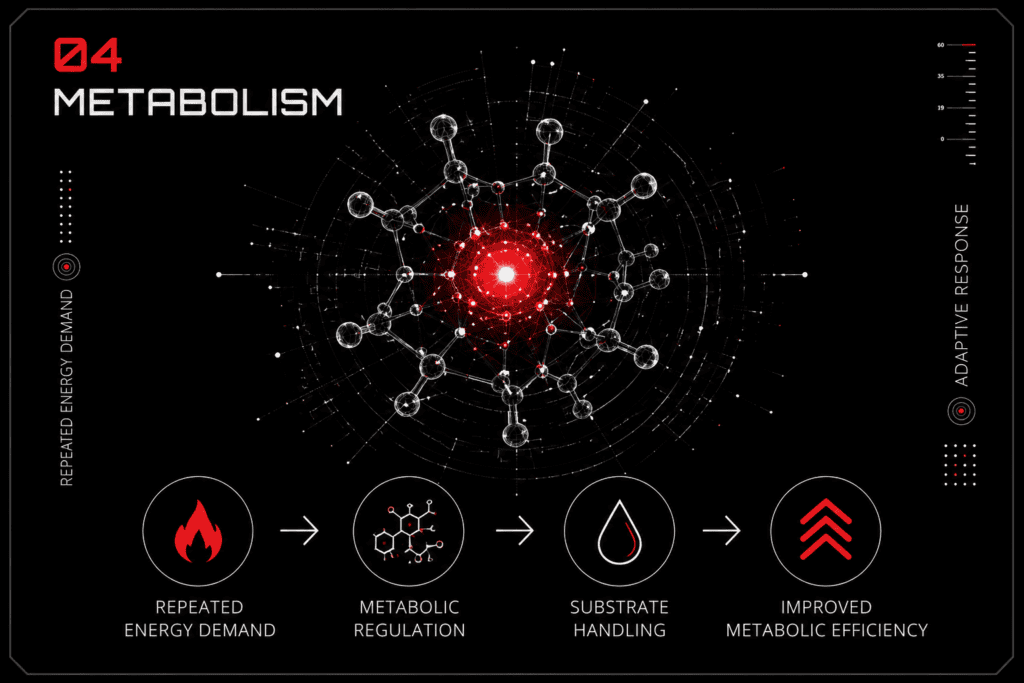
METABOLISM
Repeated nutritional and energetic conditions can influence metabolic regulation.
Biological systems adapt to recurring patterns of energy demand and substrate availability.
THE PRINCIPLE
Adaptation is specific to the conditions repeatedly imposed on the organism.
Different signals produce different biological demands.
Different demands produce different adaptations.
WHAT YOU REPEAT
BECOMES BIOLOGICALLY RELEVANT.
EVIDENCE LEVEL // ESTABLISHED
06 // THE LIMIT
ADAPTATION HAS LIMITS.
BIOLOGY OPERATES WITHIN CONSTRAINTS.
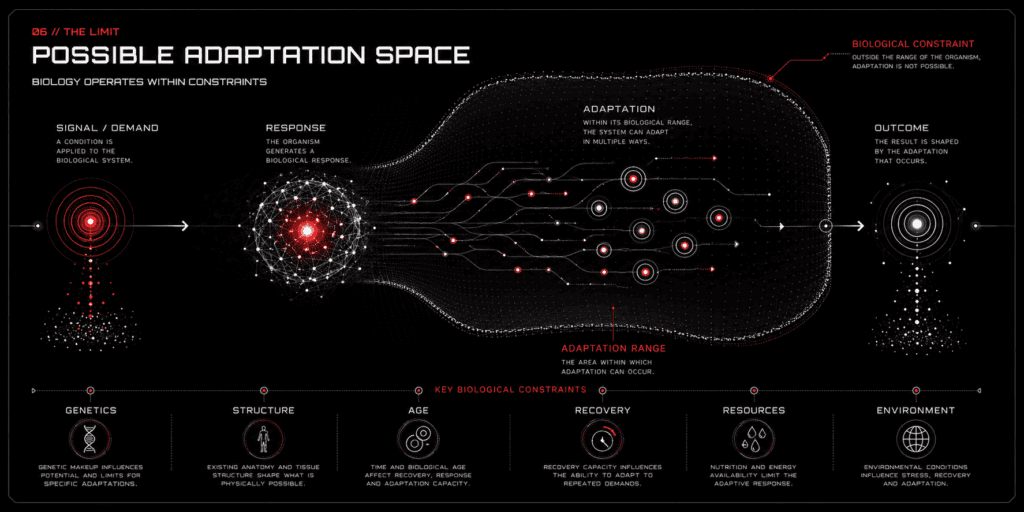
Biological systems are adaptable, but adaptation is not unlimited.
Every organism operates within structural, physiological and genetic constraints.
A signal can influence a biological system.
It cannot make every biological outcome possible.
THE CONSTRAINT
Adaptation occurs within biological boundaries.
Genetics can influence traits such as body structure, enzyme activity, fiber composition and aspects of physiological capacity.
Existing anatomy, developmental history and biological state also shape what adaptations are possible.
THE RANGE
These constraints do not mean that biological systems are static.
Within their available range, cells and tissues can alter gene expression, protein abundance, metabolic activity, structure and function in response to repeated conditions.
THE INDIVIDUAL
The same stimulus does not produce an identical result in every organism.
Training history, recovery, nutrition, age, environment and individual biology influence both the magnitude and direction of adaptation.
THE PRINCIPLE
Biological plasticity is real.
Biological possibility is not infinite.
Reprogramming does not mean escaping biology.
It means changing biological behavior within the range the organism can support.
YOU CANNOT REMOVE THE BOUNDARIES.
YOU CAN CHANGE WHAT HAPPENS WITHIN THEM.
EVIDENCE LEVEL // ESTABLISHED
07 // REPROGRAM
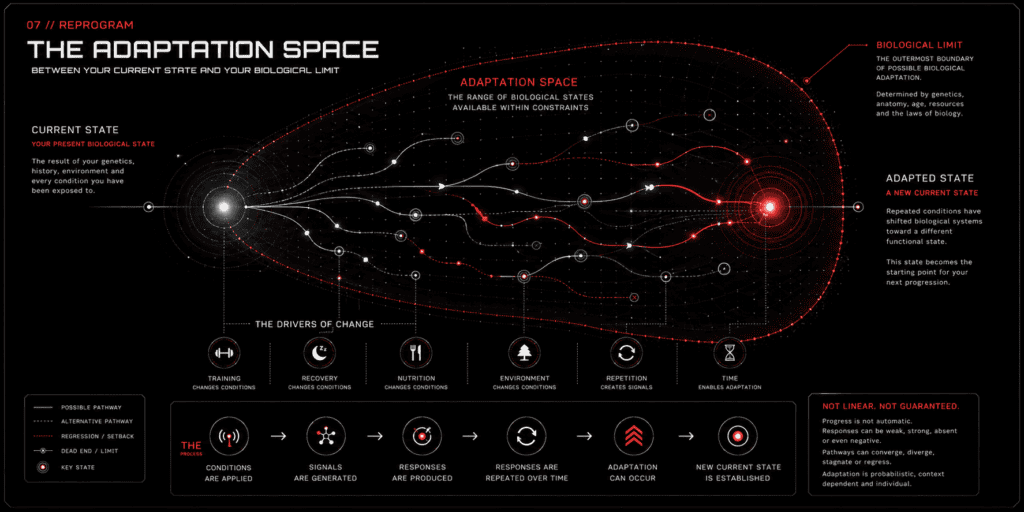
THE LIMIT IS NOT THE CURRENT STATE
An organism exists in a biological state.
That state is real. It is not necessarily permanent.
Within biological constraints, repeated conditions can alter cellular and physiological systems over time.
The current state is therefore not the same thing as the biological limit.
THE STATE
Your current biological state reflects the interaction of genetics, structure, previous adaptation, behavior and environment.
It describes where the organism is now.
It does not, by itself, describe every state the organism may be capable of reaching.
THE PROCESS
Conditions change biological signals.
Training changes conditions.
Recovery changes conditions.
Nutrition changes conditions.
Environment changes conditions.
Signals can generate responses.
When relevant responses are repeatedly produced over time, adaptation can occur.
THE PATH
Adaptation is not linear and it is not guaranteed.
Responses vary with stimulus, biological state, recovery, resources and individual constraints.
Possible trajectories can progress, plateau, diverge or regress.
THE DEFINITION
This is what CELLFORGE means by reprogramming.
Not rewriting the genome.
Not escaping biological constraints.
Not becoming biologically unlimited.
Reprogramming means changing repeated inputs and conditions in ways that can alter biological responses and, over time, biological state.
THE NEW STATE
Adaptation does not produce a final form.
It produces a new biological state.
And that state becomes the starting point for what happens next.
YOUR CURRENT STATE IS NOT YOUR ENTIRE
ADAPTATION SPACE.
EVIDENCE LEVEL // PRINCIPLE SYNTHESIS